What the mismatch is
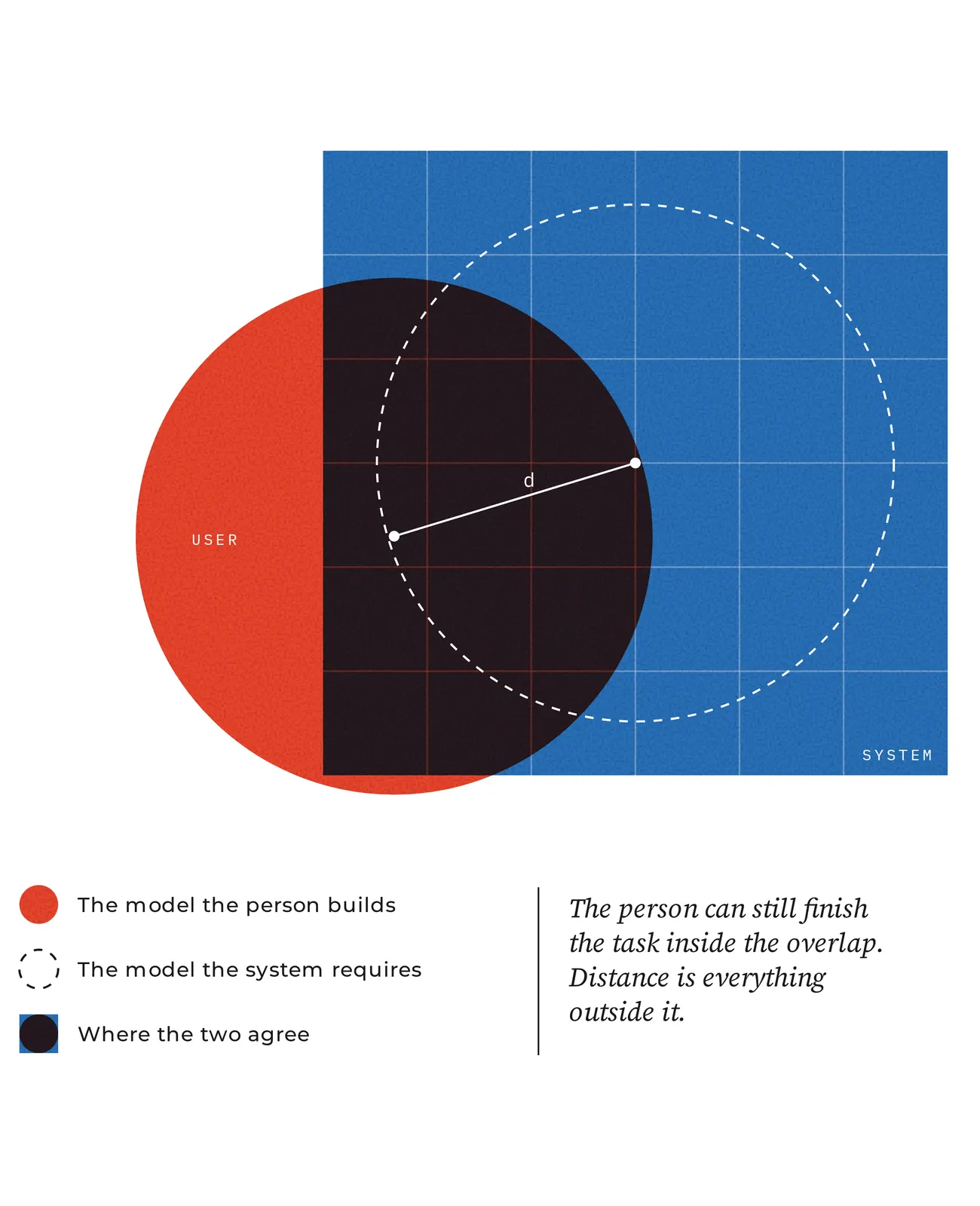
People build mental models to predict what a system will do. They draw on experience from the physical world and from other software, and they look for causes. A mismatch appears when the system’s structure, labels or sequence follow a logic the person does not share. The book’s term for the size of that gap is cognitive distance.
Four assumptions that cause it
- Rational navigation. Teams organize systems as hierarchies that mirror their departments. People think in goals and situations. A small business owner updating a license may face compliance, finance and local rules at once; to the owner it is one task, but the site splits it across three sections.
- Shared vocabulary. Terms that feel natural after months of development read differently to newcomers. “Account reconciliation” and “check your balance records” can name the same feature but suggest very different processes.
- Linear workflows. Many systems assume tasks happen in a fixed order. Real tasks get interrupted, revisited and done out of sequence, and rigid flows turn each detour into uncertainty.
- Static understanding. Teams assume people eventually learn the system. Staff turnover and occasional users show otherwise. A system that needs training to be understood is signaling distance.
Signs to look for
- Hesitation: hovering over options, rereading labels, scanning the screen again.
- Backtracking to earlier screens to test a guess about how things work.
- Private notes and checklists for tasks done every week.
- Repeating an action to make sure it really happened.
- Finishing the task and being unable to say what the system did.
How to close the gap
- Start with intentions, not categories. Organize around what people are trying to get done, in the order they do it, and show the shape of the journey.
- Use the users’ words. Take vocabulary from research, avoid system-centered phrasing, and introduce unfamiliar concepts when they matter.
- Reveal cause and effect. Make status visible and explain outcomes, especially automated decisions. Say what happened, why, and what to do next.
- Allow safe exploration. Let people try things and undo them, and offer more than one path to the same result.
- Validate understanding. Test whether people can predict and explain outcomes, not only whether they finish. See how to measure whether users understood.
Questions people ask
What is a mental model in UX?
A person’s working explanation of how a system behaves, built from experience, which they use to predict what will happen when they act. It can be accurate, incomplete or wrong.
What is the difference between a mental model and a conceptual model?
The conceptual model is the structure the system’s designers intend and the system requires. The mental model is what the person actually builds. Cognitive distance is the gap between the two.
Does simplifying the interface fix a mental model mismatch?
Not by itself. Fewer buttons and cleaner screens reduce effort, but if the structure underneath still follows a different logic, the experience gets smoother without getting more understandable.
Read more in the book
This guide is drawn from From Cognitive Load to Cognitive Distance by Izaias Cavalcanti. The whole book is free to read online and as a PDF.
- Chapter 3: Mental Models
- Chapter 7: Design Assumptions
- Chapter 8: Designing for Alignment
- What is cognitive distance?
Cite this guide
Cavalcanti, I. (2026). From Cognitive Load to Cognitive Distance: Reframing Usability and Accessibility in Information Systems. https://book.izaias.xyz/