This book began with a recurring paradox. Interfaces become faster, cleaner and technically more usable, yet confusion persists. Accessibility standards expand, yet exclusion remains visible. Artificial intelligence promises natural interaction, yet people often feel less certain about what systems are actually doing.
The argument developed across these chapters is straightforward, even if its implications are not. Many failures in modern interaction are not failures of effort; they are failures of alignment. Cognitive load explains when systems demand too much mental work. Cognitive distance explains when systems make sense in a way that is fundamentally different from how people think: when people succeed procedurally and fail interpretively.
13.1 What We Have Learned
Three lessons stand out. The first is that ease without comprehension produces dependency. A system may let people complete tasks quickly while leaving them unsure of the outcome and unable to transfer what they did to a new situation. Research on mental models has long shown that people reason about complex environments through internal representations (Johnson-Laird 1983); when systems do not support accurate ones, performance is fragile, and people succeed temporarily rather than confidently.
The second is that accessibility includes cognition. Standards such as WCAG have greatly improved perceivability and operability across the web (W3C Web Accessibility Initiative 2023), but conformance does not guarantee interpretability. A system can meet every technical requirement and still present structures that are conceptually confusing, or hand people work, like converting and compressing files, that the system could do itself. Accessibility has to include alignment with human reasoning, not only accommodation of sensory and motor differences.
The third is that complexity is unavoidable, but confusion is not. Digital systems increasingly manage finance, healthcare, education, governance and communication, and their internal complexity will keep growing. The goal cannot be to eliminate it. It is to make complexity legible, so that people can form accurate expectations about how a system will behave even when its mechanisms are sophisticated.
13.2 A Practical Framework for Closing Cognitive Distance
The recurring principles of the earlier chapters can be consolidated into four, summarized in Table 13.1 and pictured in Figure 13.1.
| Principle | Design moves | Signals to track |
|---|---|---|
| Design for mental model formation | Show cause and effect, keep metaphors consistent, explain outcomes in context | Fewer moments of uncertainty; better transfer to new tasks |
| Internalize explanation | Report consequences, not states; say why; say whether anything else is needed; absorb work the system can do | Prediction accuracy and confidence rise together; fewer support requests about hidden logic |
| Support learning over time | Progressive disclosure, contextual guidance, interfaces that grow with expertise | Rising confidence; less relearning after updates |
| Validate understanding, not only performance | Add prediction and explanation questions to usability evaluation; track the CDI on key flows | Better user explanations; more resilient behavior under change |
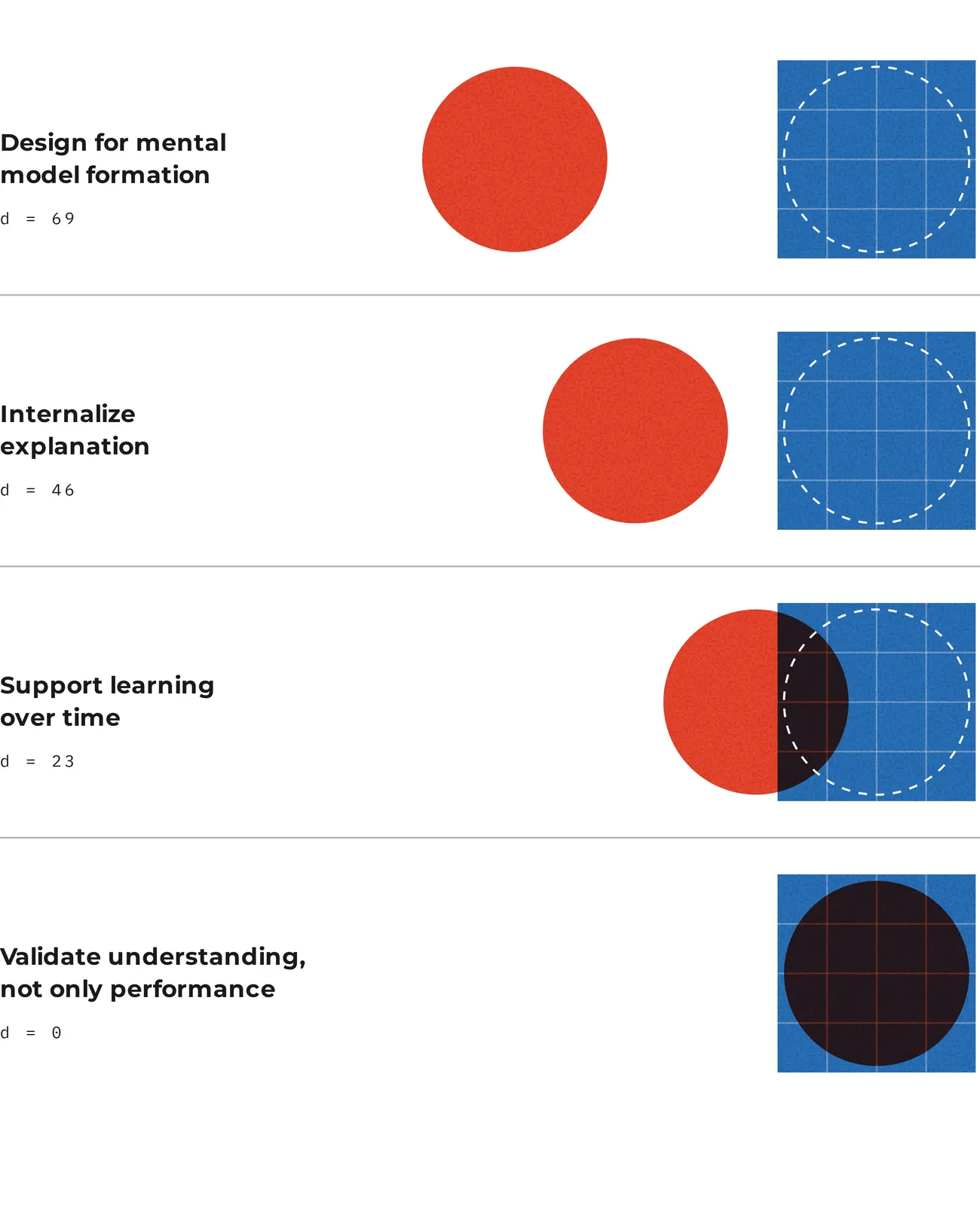
Design for mental model formation. Interfaces should help people build coherent explanations: show cause and effect clearly, keep conceptual metaphors consistent, and give feedback that explains outcomes rather than merely confirming actions.
Internalize explanation. Many systems hide their decision logic in the name of simplicity, but opacity increases uncertainty. Systems should reveal why a recommendation appears, what data influenced an outcome and how actions changed their state. Studies of explanation suggest that well-designed explanations, even partial ones, improve the accuracy of people’s mental models and help their trust match the system’s real reliability (Lim, Dey, and Avrahami 2009; Kulesza et al. 2013).
Support learning over time. Interaction does not end after first use. Progressive disclosure of advanced concepts, explanations introduced at meaningful moments and interfaces that evolve with expertise turn use into an accumulating experience instead of repeated rediscovery.
Validate understanding, not only performance. Traditional testing stops at completion. Evaluating cognitive distance means also asking whether people can predict what the system will do, explain what happened and adapt what they learned to new tasks. When people demonstrate understanding, systems become resilient to change.
13.3 Implications Beyond Design
Cognitive distance does not originate only at the interface. Organizations create it when their internal structures shape systems around institutional logic instead of user reasoning: government portals that mirror departments rather than citizens’ goals, enterprise tools that mirror database structures rather than workflows. Closing the distance therefore requires organizational awareness as well as design skill. Where digital systems function as public infrastructure, conceptual accessibility becomes a matter of equity, and policy may increasingly need to treat cognitive accessibility alongside technical accessibility. Figure 13.2 sketches how organizations can progress from basic usability towards accountable, explainable systems.
- Level 4: Accountable. The organization monitors conceptual clarity and continuously corrects opacity.
- Level 3: Explainable. The system gives meaningful reasons and states its uncertainty.
- Level 2: Understandable. Users can explain the workflow's logic and predict likely outcomes.
- Level 1: Usable. Users can complete tasks with acceptable efficiency.
13.4 The Role of the Designer and Researcher
Designers are often described as problem solvers, but another description may be more accurate: interpreters between two cognitive worlds. One works through computation, abstraction and formal logic; the other through experience, intuition and meaning-making. The designer’s task is not merely to arrange interface elements but to align these worlds so that interaction becomes intelligible. Researchers play a complementary role. They identify patterns of misunderstanding, develop models that explain them, and build and test tools, like the Cognitive Distance Index, for improving alignment. Together, design and research shape how society experiences technology.
13.5 The Distance Ahead
Human-Computer Interaction began by asking how people could adapt to machines. Over time it shifted towards making machines easier for people. The next step may be deeper: designing systems that people can understand well enough to think with, rather than merely operate. Cognitive distance offers a language for recognizing when that partnership fails, and guidance for repairing it.
Closing the distance does not mean erasing the difference between people and technology. It means ensuring that interaction stays understandable, learnable and meaningful. When people understand systems, they gain agency, and when systems align with human reasoning, technology becomes less intimidating and more empowering.
Every new technology will introduce new forms of distance, and the work will never be finished. But the direction is clearer now: not towards lighter interfaces alone, nor towards faster interaction alone, but towards understanding. That is a distance worth closing.