Digital systems no longer operate only as tools; they increasingly function as institutional infrastructure. Government services, financial systems, healthcare platforms, educational portals, transport networks and public information services all run on complex digital architectures, and for many citizens these systems are now the main way institutions reach them. Applying for benefits, submitting tax information, viewing medical records and managing bank accounts all happen through an interface. When people use such a platform, they are often dealing with the institution itself.
The design of these systems therefore shapes how people experience institutional power. Aligned with human reasoning, they can empower people and widen access to services. When cognitive distance grows, the relationship between people and institutions changes. Processes become opaque, decisions feel distant and unexplained, and what used to be administrative procedure starts to resemble an invisible bureaucracy embedded in code.
10.1 Digital Bureaucracy
Institutions encode procedures into software
Traditional bureaucracies relied on people. Citizens submitted forms, officials reviewed them, and decisions followed established procedures. In digital environments, many of those procedures are written directly into software. Applications evaluate eligibility automatically, platforms process requests by predefined rules, and data moves between institutions without anyone touching it. Public administration scholars have described this as a shift from street-level to system-level bureaucracy, in which discretion once exercised by individual officials is increasingly built into the design of information systems (Bovens and Zouridis 2002).
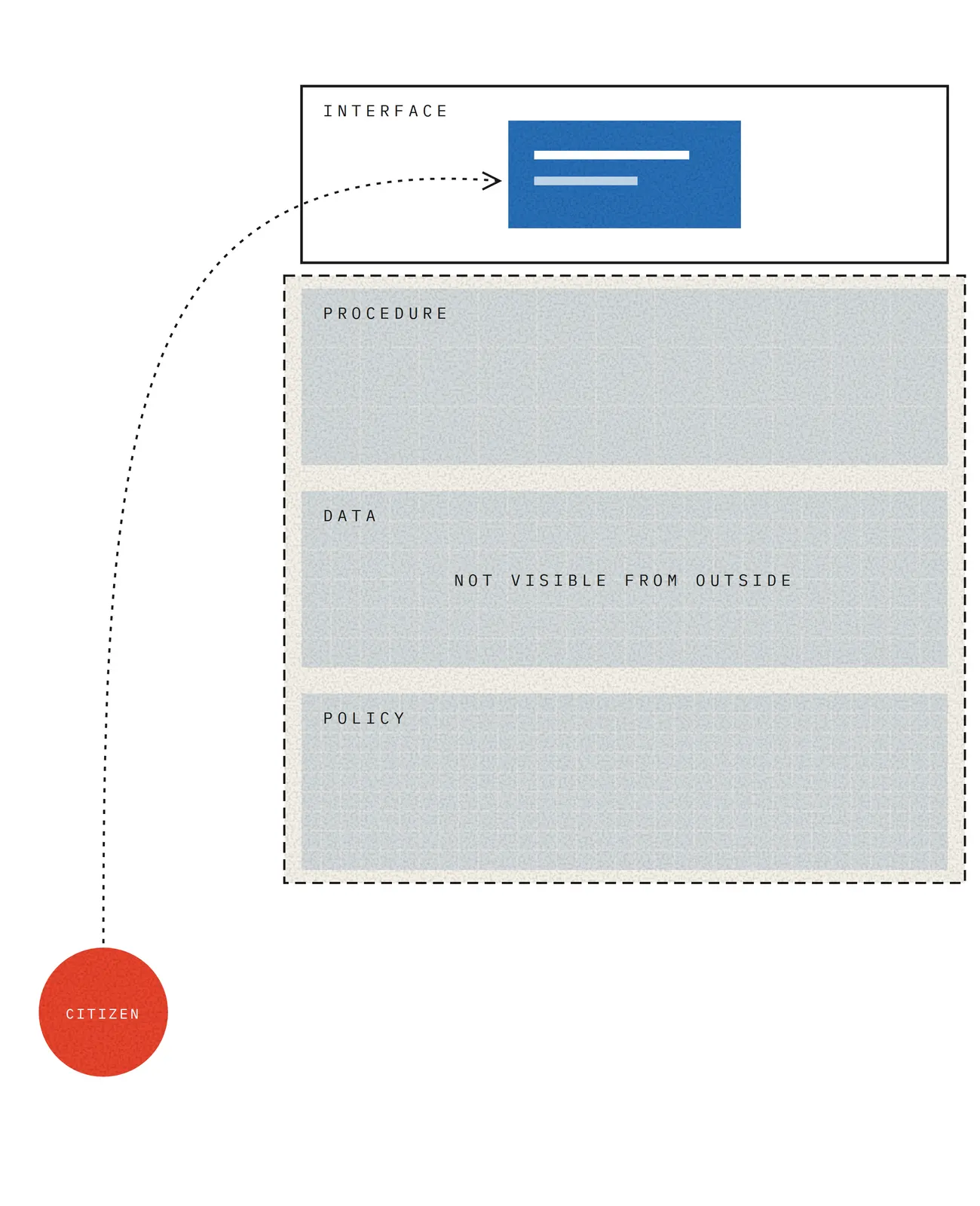
The shift can bring large gains in efficiency. Processing times fall, administrative costs drop and services are available at any hour. But it also changes how citizens experience the process. Instead of a person who can explain a decision, they meet an interface that displays an outcome. Figure 10.1 shows where institutional logic becomes hard for citizens to interpret.
Procedural logic becomes invisible
In traditional settings, administrative procedures were often visible through documentation or explanation; a clerk could walk someone through the steps a service required. In digital systems, those procedures are hidden inside the software. People see the input fields and the result, but not the reasoning in between. When an application is rejected or a request fails, the system may offer only a minimal explanation, while the logic behind the decision sits in code beyond the user’s reach. That invisibility increases cognitive distance, and citizens must trust processes they cannot interpret.
Algorithmic governance
As institutional systems become more sophisticated, organizations increasingly rely on algorithmic decision-making to assess financial risk, triage patients and allocate public resources. Scholars of digital governance have shown how such systems can shape social outcomes in powerful and often unequal ways. Cathy O’Neil documented how opaque, large-scale scoring models can reinforce disadvantage while escaping scrutiny (O’Neil 2016), and Virginia Eubanks traced how automated eligibility systems in public services fall hardest on poor and working-class people (Eubanks 2018). When algorithms determine access to services or opportunities, understanding how they work becomes critically important. Yet many remain hard for ordinary people to interpret, and cognitive distance becomes a civic concern, not only a usability one.
10.2 The Experience of Institutional Opacity
Citizens encounter systems, not organizations
People once dealt with institutional representatives directly. Visiting a government office, they could ask questions, request clarification and work through procedural complexity in conversation. Digital platforms replace much of that with structured interfaces: forms, uploads and automated workflows. Efficiency increases, but opportunities for clarification shrink. When something goes wrong, people may not know where to turn, because they are dealing with a system rather than a person.
Lack of explanation erodes trust
Institutional trust depends heavily on perceived transparency. People tend to trust systems when they believe decisions follow understandable rules, and grow suspicious when outcomes seem arbitrary. Digital systems can create that impression without meaning to. A person submits an application, the system processes it, and a result appears with no explanation. Even if the process was fair, the absence of visible reasoning creates doubt, and people start to wonder whether hidden factors decided the outcome. Cognitive distance therefore affects institutional legitimacy: understanding how systems make decisions becomes part of public trust. Table 10.1 summarizes how opacity turns into concrete consequences.
| Symptom | Likely hidden cause | Consequence for users | Design remedy |
|---|---|---|---|
| Unexplained rejection | Eligibility logic encoded in opaque rules or models | Perceived unfairness; loss of confidence in the institution | Show the key criteria and which ones were not met |
| Status uncertainty | State changes between submission and outcome are invisible | Repeated contact, anxiety, duplicate submissions | Show the stage, expected timeline and anything still required |
| Inconsistent outcomes | Cross-system data and changing rules are not communicated | Users infer arbitrariness and turn to workarounds | Show where data came from and what changed the outcome |
| Dependence on intermediaries | Language and process reflect institutional internals | Unequal access for people without expert help | Rewrite flows around citizen goals in plain language |
The rise of digital intermediaries
When systems become hard to interpret, a new kind of intermediary emerges: consultants, support agents and informal experts who help others through complex digital processes. Tax professionals interpret government filing systems, financial advisers navigate investment platforms, and technical specialists assist with enterprise software. These intermediaries play valuable roles, but their existence often reflects the conceptual complexity of the systems themselves. When digital infrastructure requires specialized interpreters, cognitive distance has grown large, and the system no longer communicates its logic directly to the people it serves.
10.3 Power, Knowledge, and System Design
Understanding systems becomes a form of power
Where digital infrastructure dominates, knowing how systems work becomes a valuable resource. People who understand a platform’s structure gain practical advantages: they move through processes efficiently, know which inputs produce which outcomes, and read system feedback correctly. For others, the system stays opaque. They may complete the same processes, but with more uncertainty and effort, and that difference can affect access to opportunities, services and resources. Cognitive distance therefore intersects with broader questions of digital inequality.
Data-driven systems amplify complexity
Many modern institutional systems depend on large-scale data integration, with information flowing between government agencies, banks, healthcare providers and digital platforms. These connections let institutions coordinate services more effectively, but they also make the overall environment more complex. A decision shown on one screen may depend on data processed by several systems behind it, and the person looking at the screen sees a single outcome with no view of the network that produced it. That layered architecture deepens cognitive distance.
Transparency as a design responsibility
Addressing these problems takes more than technical efficiency. Designers and institutions must consider how digital infrastructure communicates its logic to the people who depend on it. Transparency does not mean exposing every line of code, but systems should give meaningful explanations for important outcomes, and people should be able to understand why a process behaves as it does. Designers therefore hold a kind of institutional responsibility. The interface is where complex infrastructure meets human understanding, and reducing cognitive distance at that boundary supports not only usability but democratic accountability.
10.4 Toward Human-Centered Digital Institutions
Designing systems citizens can reason about
As institutions continue to digitize their services, designers face a crucial challenge: keeping systems interpretable enough for ordinary citizens to understand. That means communicating processes clearly, giving meaningful feedback and explaining decisions accessibly. An application system might show which eligibility criteria were evaluated and how each affected the decision, so that people see the reasoning as well as the result. The result screens of the Everyday Services Study (Table 6.3) show how small that change can be on the page and how large its effect on understanding is expected to be.
Participatory design in public systems
Another promising approach is to involve citizens directly in designing the services they use. Participatory design invites people to describe their goals, interpret prototypes and help identify conceptual barriers alongside designers. The tradition has roots in Scandinavian workplace projects of the 1970s and 1980s, associated with researchers such as Kristen Nygaard and Pelle Ehn (Ehn 1988; Schuler and Namioka 1993). Involving people in design decisions reduces the risk of embedding organizational assumptions that diverge from public reasoning, and helps digital infrastructure reflect the needs and mental models of the communities it serves.
Digital systems as civic interfaces
Increasingly, the interface through which citizens meet institutions is not a building or a person but a digital system. These systems function as civic interfaces: they shape how people understand public processes and how institutions express their authority. When they support conceptual clarity, citizens can engage with institutions confidently. When they do not, digital infrastructure becomes a barrier rather than a bridge, and closing the distance becomes essential to keeping institutional life open to everyone.
The next chapter returns from institutional analysis to design practice. If cognitive distance shapes so much of digital life, how can teams work with it directly during development?