Digital systems rarely begin with the intention of confusing anyone. In the early stages of design, teams imagine clear workflows, intuitive navigation and smooth interactions. Yet somewhere between the first idea and the final product, something shifts, and a system that seemed obvious during development feels strangely foreign to the people who eventually use it.
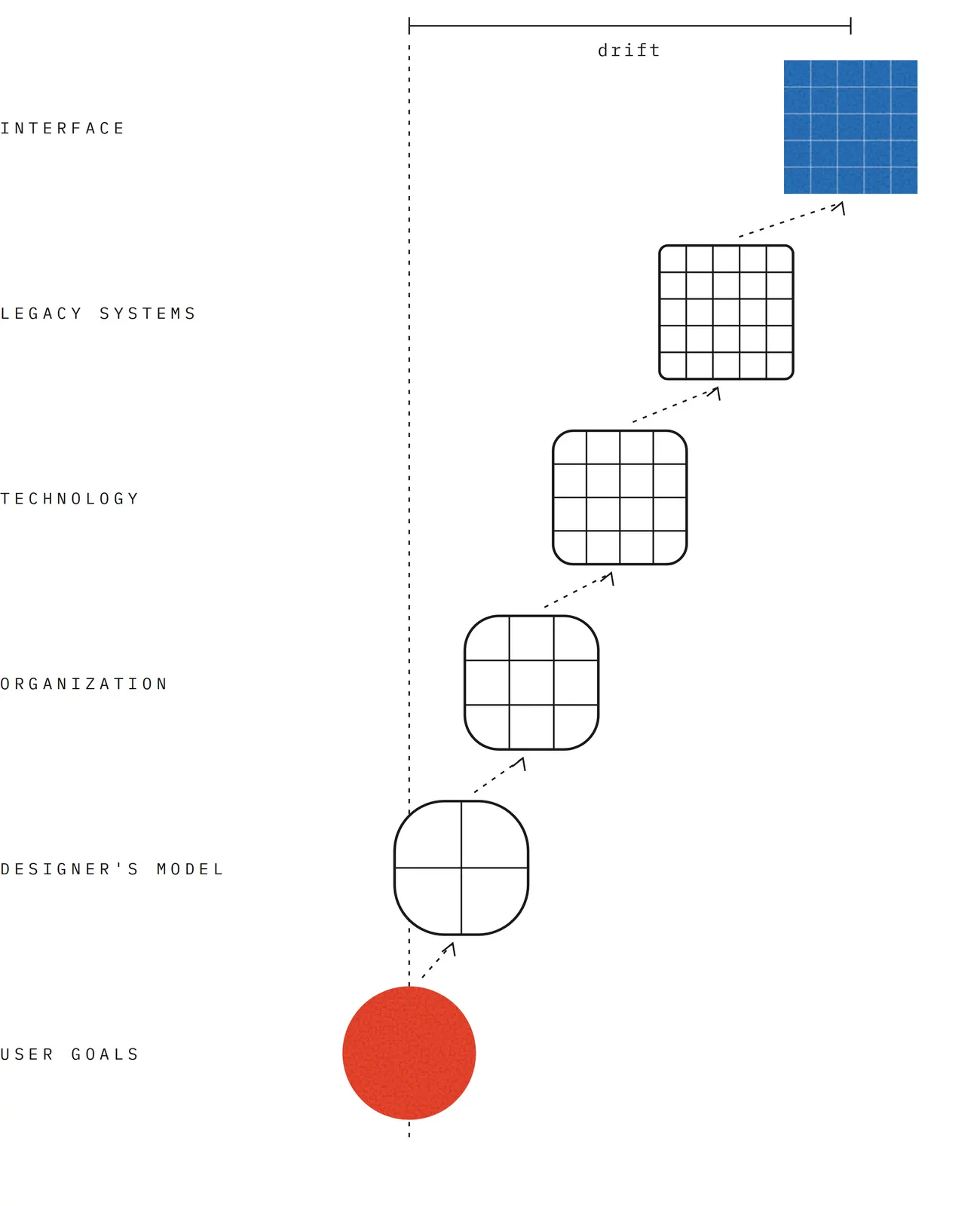
This drift does not happen because designers are careless. It happens because systems are shaped by several forces that gradually pull them away from the structure of everyday human reasoning. Understanding those forces is the first step towards reducing cognitive distance. Figure 2.1 summarizes a common path.
2.1 The Designer’s Mental Model
Designers inevitably design for themselves first
Every designer begins with a mental image of how a system should work. That image is shaped by their training, their professional tools and the internal logic of the organization building the product. When a designer imagines a system, the structure usually feels perfectly reasonable, because it fits neatly inside their own conceptual framework.
Users approach the same system from very different starting points. Designers think in terms of components, flows and architecture. Engineers think in terms of data structures and system states. Users think in terms of goals, situations and outcomes. These perspectives rarely align perfectly. A designer may organize an interface around functional modules while the user simply wants to complete a real-world task, and when that happens the system reflects the designer’s logic rather than the user’s. This is one of the earliest sources of cognitive distance.
Expertise quietly reshapes perception
As professionals gain experience, they perceive systems differently from novices. Experts learn to compress complex information into meaningful patterns, so what looks complicated to a beginner looks simple to someone with years of practice. Research on expertise has repeatedly found that experts are poor at predicting how hard a task will be for novices, and that the bias persists even when they are warned about it (Hinds 1999). Education researchers call the same effect the expert blind spot (Nathan and Petrosino 2003).
In design, it means that designers and engineers underestimate the conceptual effort a new user faces. A navigation structure that feels self-explanatory to the team may appear arbitrary to someone meeting it for the first time. The distance between expert perception and novice reasoning becomes embedded in the interface, and over time that gap hardens into the structure of the product itself.
Internal system logic becomes the interface
Another common pattern appears when internal architecture directly shapes the interface. Engineering teams organize systems according to data models, database schemas or back-end services. These structures are efficient for development and maintenance, but they do not necessarily reflect how people think about tasks. A database may separate information into categories that make sense for storage, and users then experience those categories as artificial divisions that interrupt the flow of what they are trying to do. When internal architecture leaks into the interface, users are forced to navigate the system’s logic rather than their own, and every task acquires a quiet layer of translation.
2.2 Organizational Forces That Increase Distance
Products are built by organizations, not individuals
Even when designers recognize a potential problem, the final structure of a system is rarely decided by one person. Large digital systems emerge from organizations in which several teams contribute features, policies and constraints, each with its own priorities. Product managers focus on roadmaps and business goals, engineers on stability, legal teams on compliance and marketing teams on messaging. Each of these priorities can reshape the interface. The result is often a layered system in which the user’s mental model is only one influence among many, and the interface ends up reflecting organizational structure as much as user needs.
Conway’s Law quietly shapes interfaces
In 1968 the computer scientist Melvin Conway observed that organizations design systems that mirror their own communication structures (Conway 1968). The observation became known as Conway’s Law, and its consequences are visible across digital products. A website may have separate sections controlled by different teams; a software platform may include features developed independently by different groups. From inside the organization these divisions feel natural. From outside, the system looks fragmented: each section follows slightly different conventions, navigation behaves inconsistently, and terminology changes from one context to the next. Users have to adjust their mental model every time they cross an internal boundary they cannot see.
Incremental growth produces structural drift
Very few systems are designed all at once. Most evolve gradually as features are added, workflows expand and infrastructure adapts to new requirements. Software engineering research has long recognized that a system’s structure degrades as it is changed, unless effort is spent to counter that decay (Lehman 1980). Early decisions were made under one set of assumptions and later additions respond to new goals, so the system becomes a patchwork of design eras. One part follows a task-based structure, another relies on hierarchical navigation, and a third reflects internal administrative categories. Each layer adds to the translation users must perform, and the result is a system that works in fragments but is difficult to understand as a whole.
2.3 The Hidden Influence of Technology
Technical constraints shape interaction
Every interface exists within technical boundaries. Processing power, database architecture, security protocols and integration requirements all limit what designers can realistically build, and sometimes these constraints force interaction patterns that feel unnatural. Security requirements may demand frequent authentication; data synchronization may introduce delays that interrupt a task; legacy systems may restrict how information can be reorganized. Users rarely see these limitations. They only experience the resulting behavior, and from their perspective the system simply feels confusing or inconsistent. Such compromises can widen cognitive distance even when designers work hard to minimize it.
Legacy systems shape modern interfaces
Many digital systems are not built from scratch but on top of older infrastructure that was never designed for modern interaction. Government systems provide many examples. Public service portals often connect decades-old databases to newer web interfaces, and while the interface may look modern, the underlying logic still reflects the legacy system. This mismatch produces strange workflows. Users enter the same information several times, tasks are split across unrelated pages, and navigation follows administrative categories rather than real-world goals. The interface acts as a thin layer over an older conceptual model, and users sense the misalignment immediately.
Automation introduces new conceptual gaps
As systems incorporate automation and artificial intelligence, another source of distance emerges. Automated systems often operate through statistical models or algorithmic rules that do not map onto traditional interface metaphors. A recommendation engine suggests products based on behavioral patterns; an AI assistant generates text by predicting likely sequences of words. To engineers these mechanisms make sense. To users the behavior can appear unpredictable or mysterious, and without clear explanations people struggle to build stable mental models of it. The gap is no longer only between interface structure and human reasoning. It also includes the invisible logic of algorithms operating behind the interface, a theme Chapter 9 takes up in detail.
2.4 Recognizing the Pattern
Taken together, these forces show that cognitive distance is rarely the result of a single mistake. It grows gradually as systems evolve under several influences at once. Designer expertise introduces subtle assumptions, organizational structures shape navigation and feature boundaries, technical constraints impose unexpected interaction patterns, and automation adds opaque decision processes. Each moves the system slightly further from the user’s way of thinking. The distance accumulates until people encounter a system that technically works but conceptually feels foreign. Seeing the process clearly is the first step towards designing systems that stay aligned with human reasoning.