1.1 The Strange Persistence of Confusing Systems
For more than four decades, Human-Computer Interaction has tried to answer a simple question: why do people struggle with digital systems (Card, Moran, and Newell 1983; Norman 1988; Shneiderman 1983)? At first, the answer looked technical. Computers were new, interfaces were primitive, and users needed time.
Then everything improved. We moved from command lines to graphical interfaces. Processing power exploded. Design became a profession, and usability became a discipline. Still, confusion stayed.
People hesitate before they click, repeat actions to make sure a task really completed, and feel one mistake away from breaking something important. This happens in daily, high-stakes situations. Patients struggle with medical portals. Employees depend on internal help desks for tools they use every week. Citizens abandon government forms midway through critical processes. AI tools produce fast outputs while users remain unsure how the results were generated. These are not rare edge cases; they are ordinary moments in modern digital life.
1.2 When Systems Think Differently Than People
Every system carries a model of the world. Designers define categories, labels and flows. Engineers define structures, states and constraints. Product teams define success paths. Users arrive with their own models, built from daily life, prior tools, work habits and cultural expectations.
When those models align, interaction feels natural. Users can predict outcomes and recover from mistakes with confidence. When they do not, interaction becomes translation work. Users stop focusing on their goals and start guessing what the system expects. Even a clean interface can feel mentally noisy when people must decode hidden logic at every step. This is where cognitive distance begins.
1.3 Usability Success That Still Feels Wrong
Traditional usability metrics matter. Time on task, completion rates and error rates all provide useful signals (Seffah and Metzker 2004). But these measures can hide a deeper problem: a user can complete a task and still not understand the system.
Many people succeed by memorizing sequences instead of building real understanding. The moment a label changes or a step moves, their performance collapses. The interface looked successful, but the relationship between user and system remained fragile. That fragility is expensive. It drives support costs, retraining cycles and persistent frustration (Ceaparu et al. 2004).
1.4 The Limits of Simplification
When teams see friction, they often simplify. Simplification is valuable, but on its own it is not enough. A minimal surface can still hide a confusing structure. A system may show fewer options while preserving a model that does not match how people think, and in that case visual simplicity masks conceptual complexity.
The contrast is especially visible in AI products. A single input field looks easy, but behind it sits a complex system with unclear boundaries. Users must infer what to ask, what the model can do, and why the quality of its output changes. Low visible effort does not guarantee low cognitive distance.
1.5 The Emergence of Cognitive Distance
As usability practice matured, a repeating pattern became easier to spot. In interviews and think-aloud sessions, people said things like “I can use it, but I am never fully sure,” “I just follow the steps,” or “I don’t know why it works.” These are not statements about laziness or lack of skill. They describe a structural mismatch between the logic a system runs on and the reasoning a person brings to it.
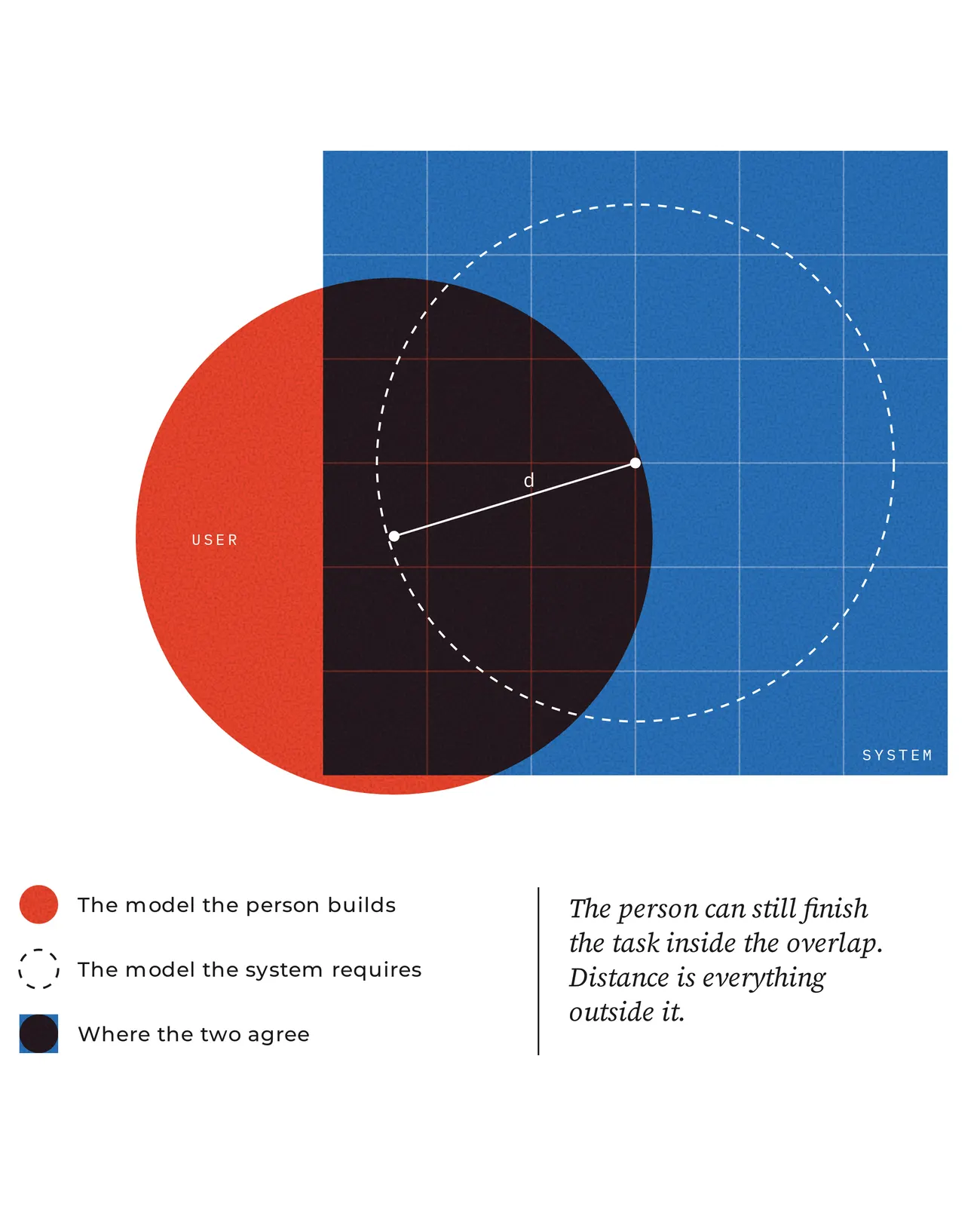
This book calls that mismatch cognitive distance, and it uses the term in a precise sense. Figure 1.1 draws the idea.
Cognitive distance is the degree of mismatch between the conceptual structure that a system requires for correct interpretation and the mental model that a user actually constructs during interaction.
Low cognitive distance exists when people can predict what a system will do before they act, explain what happened afterwards in their own words, and carry that understanding into the next, slightly different situation. High cognitive distance exists when people complete actions without a coherent account of what produced the outcome, even when they act quickly and without any sense of strain.
Three properties distinguish the construct from the ideas it sits beside, and they recur throughout the book.
It is relational. Cognitive distance is not a property of the system alone or of the user alone. It describes the fit between a system’s structure and a particular population’s capacity to interpret it. The same result screen can sit close to a bank employee who knows settlement terminology and far from a first-time customer who does not. Any measurement of distance therefore has to say whose distance is being measured.
It is cumulative. Mental effort rises and falls from moment to moment within a task. Distance accumulates across interactions and across design decisions. Each choice that favors internal system logic over user-facing interpretability adds a small increment, and each missed opportunity to explain an outcome adds another. This is why an evaluation conducted at a single moment can underestimate the long-term cost of an opaque system, and why Chapter 5 describes the result as a form of debt.
It can be high when effort is low. This is the defining property, and the main reason the concept is not redundant with existing frameworks. An interaction can be brief, clean and effortless while leaving the user with no idea what happened. The user presses Confirm and sees a result in under five seconds. The screen contains few words, no errors occur, and performance metrics report success. Cognitive distance is at its maximum.
Once this lens is applied, many familiar failures become easier to explain.
1.6 Cognitive Load Versus Cognitive Distance
Cognitive load and cognitive distance are related, but they are not the same. Cognitive load asks how much mental effort a task requires right now (Sweller 1988, 2011). Cognitive distance asks how far a system is from the way its users frame the task. Put another way, load concerns the cost of performing actions a person understands; distance concerns the gap that exists before the person even knows what is being asked.
Because the two are separate, a flow can have low load and high distance, or moderate load and low distance. Booking travel involves several steps, yet most people understand the sequence because it matches everyday planning logic. By contrast, a short form can feel difficult if its order and language reflect internal data structures rather than user goals. Design improves fastest when teams measure both effort and alignment. Figure 1.2 shows the four conditions that result.
| Low load | High load | |
|---|---|---|
| High distance | Easy but opaqueInteraction looks easy, but understanding is fragile. People finish without confidence. This is the failure effort-based evaluation misses. | Demanding and opaqueThe most fragile condition. Tasks feel difficult and the system’s logic feels alien. |
| Low distance | Effortless and clearFast, clear interactions. People understand what to do and why it works. | Demanding but transparentEffort is high, but people build stable understanding because the structure is coherent. |
1.7 Where the Idea Comes From, and What It Is Not
The phrase cognitive distance is newer than most of the ideas it brings together, and it is not new in every field. Readers who have met it elsewhere deserve a clear account of how this book’s use relates to earlier ones.
Norman’s gulfs. The closest ancestor in Human-Computer Interaction is Donald Norman’s distinction between the gulf of execution, the gap between what a person wants to do and the actions a system makes available, and the gulf of evaluation, the gap between what a system shows and what the person can conclude about its state (Norman and Draper 1986; Norman 2013). Hutchins, Hollan and Norman went further and described two kinds of distance a user must bridge: semantic distance, between what the user wants to express and what the interface’s language can express, and articulatory distance, between that meaning and the form of the input. They argued that direct manipulation feels natural because it shortens both (Hutchins, Hollan, and Norman 1985). Cognitive distance, as used here, is closest to the gulf of evaluation, but it differs in two ways. It concerns the user’s accumulated model of why the system behaves as it does, not only whether its current state is legible. And it is meant to be measured, with the instrument described in Chapter 6, rather than only described.
Mental model research. A long tradition in cognitive psychology studies the internal representations people build of devices and situations (Johnson-Laird 1983; Gentner and Stevens 1983; Kieras and Bovair 1984). That research asks a descriptive question: what model has this person built? Cognitive distance asks an evaluative one: how far is that model from the one the system requires? The second question is more directly useful to designers, because it supplies both a criterion for comparison and a signal for intervention.
Spatial cognition. In environmental psychology, cognitive distance means a person’s mental estimate of the physical distance between places, which departs systematically from measured distance (Montello 1991). The methods Montello reviewed for eliciting and validating such estimates are a useful reminder that a mental quantity can be measured rigorously, but the construct itself is unrelated: it concerns geography, not systems.
Organizational learning. In economics and innovation studies, Bart Nooteboom uses cognitive distance for the difference in knowledge and perspective between organizations, arguing that partners learn most at an intermediate distance: close enough to understand each other, far enough to have something new to offer (Nooteboom 2000; Nooteboom et al. 2007). This book borrows nothing from that model except the spatial metaphor. Here, distance is never a resource to be optimized. It is a cost that falls on the person trying to use a system, and the design goal is always to reduce it.
Cognitive distance does not replace any of these contributions. It gives a single name, a working definition and a measurement approach to a failure that each of them touches but none of them isolates: the user who succeeds procedurally and fails interpretively.
1.8 Why Cognitive Distance Matters Now
Today, digital systems sit inside almost every important human process. Healthcare, education, finance, employment and public services all depend on tools that people must understand under pressure. Meanwhile, systems are becoming more adaptive and more opaque. Recommendation engines, automated decisions and AI-generated content can feel useful yet remain hard to interpret (Weiser 1991; Zhang, Wang, and Yi 2025). As opacity grows, conceptual alignment becomes more important, not less.
If users cannot form stable mental models, they cannot build durable trust, and when trust erodes, adoption becomes shallow and fragile. Chapter 2 explores how misalignment grows during design and delivery, and why even well-intentioned teams drift away from human reasoning over time.